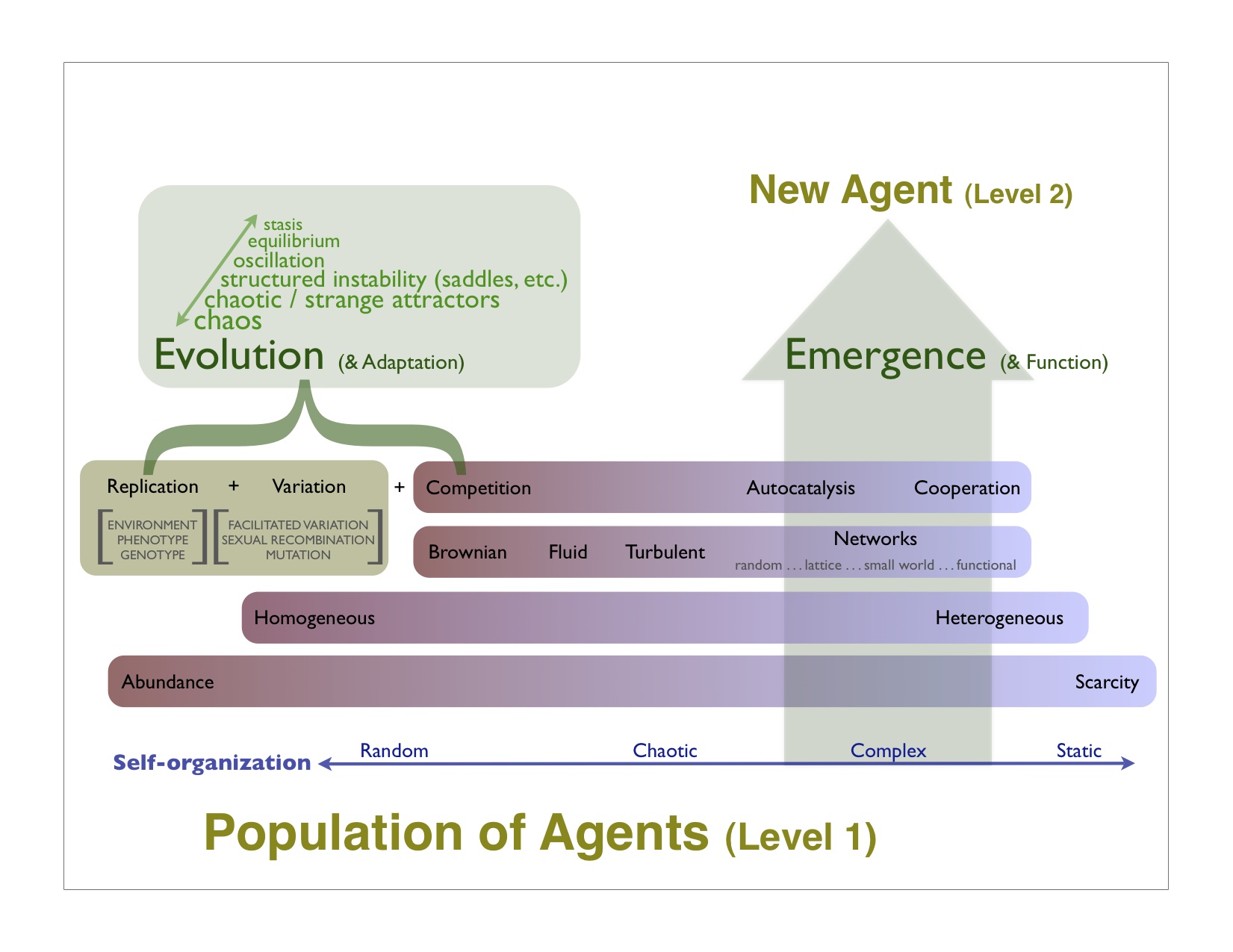
The complexity paradigm uses systemic inquiry to build fuzzy, multivalent, multi-level and multi-disciplinary representations of reality. Systems can be understood by looking for patterns within their complexity, patterns that describe potential evolutions of the system. Descriptions are indeterminate and complimentary, and observer dependent. Systems transition naturally between equilibrium points through environmental adaptation and self-organization; control and order is emergent rather than predetermined.
A CAS behaves/evolves according to three key principles: a.- order is emergent as opposed to predetermined, b.-the system's history is irreversible, and c.-the system's future is often unpredictable.
The basic building blocks of the CAS are agents. Agents are semi-autonomous units that seek to maximize some measure of goodness, or fitness, by evolving over time. Agents scan their environment and develop schema representing interpretive and action rules. These schema are often evolved from smaller, more basic schema. These schema are rational bounded: they are potentially indeterminate because of incomplete and/or biased information; hey are observer dependent because it is often difficult to separate a phenomenon from its context, thereby identifying contingencies; and they can be contradictory. Schema exist in multitudes and compete for survival.
Existing schema can undergo three types of change: first order change, where action is taken in order to adapt the observation to the existing schema; second order change, where there is purposeful change in the schema in order to better fit observations; and third order change, where a schema survives or dies because of the Darwinian survival or death of its corresponding CAS. Schema can change through random or purposeful mutation, and/or combination with other schema. Schema change generally has the effect of making the agent more robust (it can perform in light of increasing variation or variety), more reliable (it can perform more predictably), or grow in requisite variety (in can adapt to a wider range of conditions).
The fitness of the agent is a complex aggregate of many factors, both local and global. The general health or fitness of the agent determines what the probability of change will be. Optimization of local fitness allows differentiation and novelty/diversity; global optimization enhances the CAS coherence as a system and induces long term memory. In general the probability of second order schema change is a nonlinear function of the fitness value.
Schema define how a given agent interacts with other agents surrounding it. Actions between agents involve the exchange of information and/or resources. These flows may be nonlinear. Information and resources can undergo multiplier effects based on the nature of interconnectedness in the system. Agent tags help identify what other agents are capable of transaction with a given agent; tags also facilitate the formation of aggregates, or meta-agents. Meta-agents help distribute and decentralize functionality, allowing diversity to thrive and specialization to occur. Agents or meta-agents also exist outside the boundaries of the CAS, and schema also determine the rules of interaction concerning how information and resources flow externally.